Advanced Respiratory Testing for Accurate Diagnosis
Lung function testing provides valuable information about how well your lungs are working, helping to assess airflow, lung capacity and overall respiratory function. These specialised tests play an important role in diagnosing respiratory conditions, evaluating symptom severity and monitoring response to treatment over time.
At Melbourne Respiratory & Sleep Services, lung function testing is performed using advanced diagnostic equipment and interpreted by experienced respiratory specialists. The results help guide accurate diagnosis and support personalised treatment plans for patients with a wide range of respiratory conditions.
Comprehensive Lung Assessment
Detailed testing to measure lung volumes, airflow and respiratory performance, providing a clear picture of lung health.
Accurate Diagnostic Support
Objective respiratory measurements help diagnose and differentiate conditions affecting breathing and lung function.
Ongoing Monitoring
Regular testing can assist in tracking disease progression, assessing treatment effectiveness and supporting long-term respiratory care.
Different lung function tests
Spirometry
Spirometry measures the amount of air in the lungs and how fast it moves through the airways when you exhale. By measuring how much air you exhale, and how quickly, spirometry can evaluate a broad range of lung diseases. This test involves breathing into a mouthpiece connected to a machine called a spirometer. You will be given a soft nose clip to wear during the procedure so that all of the air you breathe travels through your mouth, rather than your nose. You will be asked to take as big a breath in as you can and then exhale all the air out as quickly and completely as possible. In some cases, you may be asked to repeat the test after taking a medication that relaxes the airway muscles (such as Ventolin) to determine the effect of that medication on your results.
Transfer factor
To measure transfer factor, you breathe a harmless gas for a very short time. The amount of the gas in the air you breathe out is then measured. The difference in the amount of gas inhaled and exhaled measures how effectively gas travels from the lungs into the blood. This test allows the doctor to estimate how well the lungs move oxygen from the air into the bloodstream
Plethysmographic lung volumes
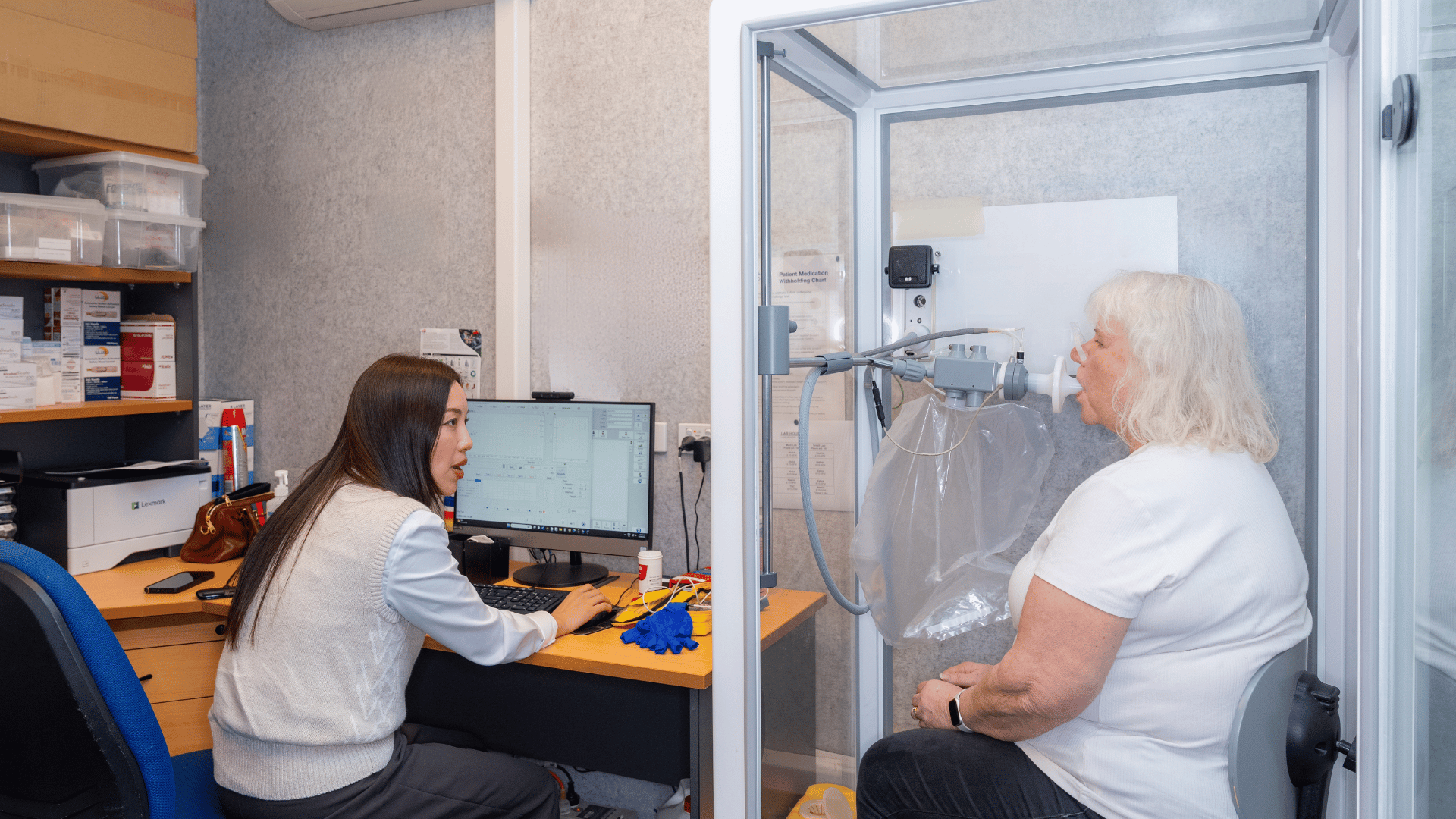
For this test, you sit inside a small airtight box similar to a phone booth and breathe into a mouthpiece while pressure and air flow measurements are collected. The changes in pressure inside the box are used to calculate the amount of air inside the lung as you breathe. From inside the box you will be able to see and hear the instructions of the staff member carrying out the test.
Bronchial provocation testing
Bronchial provocation tests are done to measure the response of your airways to substances that may be causing asthma or wheezing. This test involves spirometry as described above. You will be asked to repeat the spirometry test several times after inhaling the challenge agent, usually in slowly increasing amounts. By doing this, the doctor can establish how sensitive your airways are to agents that can provoke wheezing.
Maximal respiratory pressures
These tests measure the strength of the muscles used to breathe. You will be asked to breathe in and then out into the mouth piece as strongly as you can.
FeNO (Exhaled Nitri Oxide)
A FeNO test or exhaled nitric oxide test, in patients with allergic or eosinophilic asthma, is a way to determine how much lung inflammation is present and how well inhaled steroids are suppressing this inflammation. With allergic or eosinophilic asthma, sometimes you may feel your breathing is fine, but when you measure your exhaled nitric oxide, it may still be significantly elevated, and you might do better in the long-term using slightly more of your inhaled steroid to suppress this inflammation.